I got a chance to go and see the Milwaukee bucks take on the Boston Celtics live at the stadium, and although I am not the most ardent of basketball fan, I had an awesome time there. It was fun supporting 'my' team even though the Bucks don't have any star player that I have previously seen in action. To top if off, the Bucks did infact manage to win :)
Sunday, April 08, 2007
Milwaukee Bucks!
I got a chance to go and see the Milwaukee bucks take on the Boston Celtics live at the stadium, and although I am not the most ardent of basketball fan, I had an awesome time there. It was fun supporting 'my' team even though the Bucks don't have any star player that I have previously seen in action. To top if off, the Bucks did infact manage to win :)
Saturday, March 31, 2007
Not a Mustang ..
Wednesday, February 28, 2007
My Next Car?


Maybe! I like the Mustang, though its not a true sportscar in the conventional sense. The first couple of pics are of the new 2005/06 Mustang and I like the 'I mean business' look. Unfortunately even if I go for a Mustang I might just end up buying a used previous model, which though decent looking is not nearly as sexy as the new one.
The first Mustang rolled out in 1964 and it gave rise to a class of automobiles called Pony Cars, which stood for affordable, compact, highly styled car with a sporty or performance-oriented image. And if you compare the price tags of a Mustang vis a vis the more recognized sportscars like porsche and bmw you will see what they mean.
Sunday, February 25, 2007
Wisconsin Snow
Wednesday, October 18, 2006
Heard on the TV
I heard this quote on the TV quite a while back but it got stuck in my head. Maybe because it is so true! Isn't it true that we are in a contant struggle to control and plan every aspect of our lives instead of just letting go and enjoying. It is tough to do that, to cave in and agree that there are things not within out control. The danger of the flip side is people taking no responsibily for their condition and blaming their fate, oh well ... its a tough balance. Nobody said it would be simple.
Thursday, July 07, 2005
sad day in London ... and the World
Writing after a pretty long time but the events of early morning
galvanized me into expressing some of my views.
Its really sad what happened today and in a broader scope whats happening in the world- with respect to the 'war on terror' and the whole west (mainly US/UK) vs so called terrorists. It is indeed a problem but my view ( along with a major proportion of the general public around the world) is that the approach taken by the US is highly myopic and dangerous.
War can never be an instrument for peace and love. If the US thinks that it can go all around the world and kill all the 'terrorists' then, in my view, it is in for a rude shock! Can a son who has lost his father or a man who's family has been killed without any reason actually dig deep into his heart and forgive the people who did this, however noble the alleged motives are. These people will spend every second of their lives hating the guts of the west. So instead of reducing the problem, war only helps it propogate and multiply. An eye for an eye leads to a world which just can't see.
The only solution is peace, prosperity, growth: Economics. Bring as many people as possible into the mainsteam. Make them realise what the world/ life has to offer. If nothing else get people addicted to material goods, make their lives busy with the headache of day to day problems- paying bills, supporting families. Then lets see how many have time to go out and 'kill' people. I know its not that simple, but it seems a much better alternative to me. The New York Times columnist Thomas Friedman claims that there has never been a war between two countries which have operating branches of McDonalds. When poeple get busy with their work and the economy functions at a good capacity, war becomes too expensive. Some may argue that so called terrorism is not actually a war rather its a clash of ideaology, but my claim- get people occupied and show them alternatives and suddenly the supply of unlimited manpower will dry up. There may be a few who would not be charmed, but they would'nt wield much power.
Other news: Saudi Arabia says that it wont' be able to match the oil demands of the west in the future say 10-15 years from now. This is a big thing! Even now the world economy is struggling with exhorbitant oil prices of $60 a barrel!. The time has come when the world has to SERIOUSLY consider alternative sources of energy. Why I saw SERIOUSLY is because in my view the efforts untill now have been nothing but meek with most of the work done by small scale researchers and companies. The good thing about high oil prices is that this will make unconventional and new technologies economically viable. The G8 summit this week is also focussing on Climate Changes due to green house effect and this should add to the momentum of the 'going green' movement. One thing for sure, technologically we are not far behind- its the leadership and initiative that is missing. Given a correct framework and some encouragements, alternative sources of energy can compete with oil.
Tuesday, June 28, 2005
Monday, June 20, 2005
Soulful Lyrics
A couple of very beautiful songs from a very old movie Anari that I have been listening to lately. Its difficult to find more soulful and meaningful lyrics, and when Mukesh sings them ... you just have to listen ..
Sab Kuch Seekha
Saab kuch seekha hamne na seekhi hoshiyari
Sach hai duniyawaalon ki hum hain anaadi
Duniya ne kitna samajhaya
Kaun hai apna kaun paraaya
Phir bhi dil ki chot chupa kar
Hamne aapka dil bahalaaya
Khud pe mar mitne ki ye zid thi hamari (2)
Sach hai duniyawaalon ki hum hain anaadi
Asli nakli chehre dekhe
Dil pe sau sau pahre dekhe
Mere dukhte dil se poochho
Kya kya khwaab sunahare dekhe
Toota jis taare pe nazar thi hamari (2)
Dil ka chaman ujadte dekha
Pyaar ka rang utarte dekha
Hamne har jeene waale ko
Dhan daulat pe marte dekha
Dil pe marne waale marenge bhikhari (2)
Sach hai duniyawaalon ki hum hain anaadi
Jeena Issi Ka Naam Hai
(Kisiki muskuraahaton pe ho nisaar
Kisika dard mil sake to le udhaar
Kisike waaste ho tere dil mein pyaar
Jeena issi ka naam hai) -2
(Maana apni jeb se fakeer hain
Phir bhi yaaron dil ke ham ameer hain) -2
Mitte jo pyaar ke liye woh zindagi
Jale bahaar ke liye woh zindagi
Kisi ko ho na ho hamein to aitbaar
Jeena issi kaa naam hai
(Rishta dil se dil ke aitbaar ka
Zinda hai hameen se naam pyaar ka) -2
Ke mar ke bhi kisi ko yaad aayenge
Kisi ke aansuon mein muskuraayenge
Kahega phool har kali se baar baar
Jeena issi kaa naam hai
Kisiki muskuraahaton pe ho nisaar..
Saturday, June 04, 2005
Dream come true

Found this article on nytimes and liked the way he described his first few mins in a ferrari !! ....
EVER wonder what it would be like to see the face of eternity at 183 miles per hour on the West Side Highway? I sure did. So on a recent Thursday morning, I slipped into the cockpit of a red Ferrari 360 Modena.. Then I wheeled onto the highway at 59th Street, and put the pedal to the metal.
The first thing I heard was the apocalyptic thunder of the Ferrari's rear-mounted 400-horsepower V-8 engine. The first thing I felt was awe - and then absolute terror. The G-force of the Ferrari's acceleration slammed me back against my black leather bucket seat. My stomach leapt to my Adam's apple. The sky and the pavement flattened out into what looked like a solid curtain.
Then I glimpsed a shining, crescent-shaped tear in the curtain. All of a sudden, I realized that the face of eternity was grinning at me. I had just hurtled from 0 to 60 m.p.h. in less than five seconds. But I was barely over the posted speed limit, and still 123 m.p.h. short of the Ferrari's top speed.
That's when I gave silent thanks for three not-so-small favors. The first was that I hadn't blown out my breakfast. The second was that the Ferrari 360 Modena is blessed with some of the best brakes ever invented, combining a proportioning valve and an ABS system to prevent the wheels from locking up when decelerating. The third favor was that I had the presence of mind to use those fancy brakes.
As I slowed to 45 m.p.h. and exited at 96th Street, the sky, the pavement, and my stomach returned to their customary positions. As of this writing, my adrenaline rush continues unabated. ...
Unless you have a heart condition or a terminal case of the goody-two-shoes, you simply have to consider taking a spin in an exotic car
Tuesday, May 24, 2005
Masters of Science

Another sem comes to an end. Well ... it ended a week back, but the
wierd thing is that I have been more lazy in updating my blog when I
dont have much work than when my exams were going on. The semester
itself was fun and as usual, a whole lot informative. I had a couple of
pretty simple finance MBA level courses balanced out with the tough math
course. In the end things turned out pretty decent. The sem also saw me
completing my requirements for my masters degree. So now I am officially
Masters in Electrical and Computer Engineering, though I will file for
graduation at the end of the summer session. The graduation ceremony
though was awesome and having missed my undergraduate ceremony, I made
it up more than adequetely by attending the ceremony thrice! .. for
Akash, for Jeremy .. and ofcourse for mua :-)
But things at my end are hardly quite. The summer session has started and I
am sitting through a course on corporate finance. I plan to just go to
the lectures and absorb as much as I can from what the prof says. I
liked the way the prof just used discussion as the medium of teaching ..
rather than lecturing. The independent study has also started. So I
guess now I have to buckle up and work .. which I have not been doin
lately. Prof Brown wants me to read some stuff over a few weeks and then
dive into research. Sounds like a really nice idea, and I hope to make
most of my opportunities
Tuesday, May 10, 2005
photo

10 May 2005 REUTERS/David Gray
Saturday, May 07, 2005
photo

07 May 2005 REUTERS/China Newsphoto
The Impossible Trinity
Now what exactly in money and what does the exchange rate movements signify. Since money is just paper, all its value comes from the faith that people have in its value. Inflation is something that eats into the purchasing power of money. How stable and strong the currency is depends on the inflation - and indirectly on the faith that poeple have in the central bank of a country. If they think the central bank would not let inflation be too high so that the money in their hand does not lose purchasing power, the currency would be relatively strong. Currency market is forward looking, i.e it inticipates what will happen in the future and incorporates that today. So if people sense that inflation would eat into their purchasing power, the currency will start losing value. This is generally in a longish time frame. Day to day fluctuations for currencies that float freely is just caused by supply and demand. Thinking of currencies as commodities, currencies which are in demand gain value and currencies in less demand lose value. The one certainty with currency markets is that it is nearly impossible to predict which way the currency will move and when. There are so many complex economic, political and financial factors that drive the whole thing.
A cool concept is foreign exchange regimes is what is known as the impossible trinity. (Shown Below)
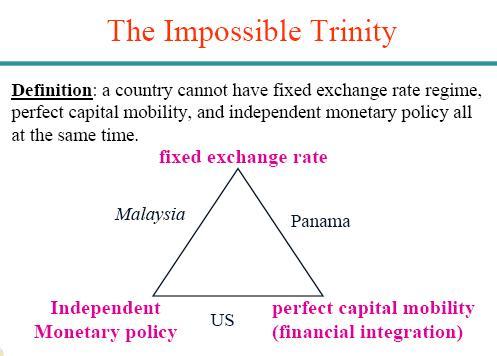
If a country tries to implement any of the two above, it has to forgo the third. Take the case of India. Say of we want an independent monetary policy and fixed exchange rate. In this case we would need to impose capital control. Why? Say lots of people want to invest in india and start demanding more and more rupees. This will cause the interest rates to rise. But we have an independent monetary policy, so the central bank buys bonds in the market and increases the money supply to ease the pressure. But under this situation it is impossible to maintian a fixed exchange rate cause the speculators see that your currency is appreciating and you are not allowing the value to go up. They will then launch attacks on your currency which you wont be able to defend for long since you have allowed free capital mobility.
Anyways, I found this article on rediff addressing same scenario wrt the RBI policies ..
RBI and the 'dirty trinity'
The "impossible trinity" in monetary policy is achieving three things at the same time: exchange rate stability, free flow of international capital and an autonomous monetary policy (which means the ability to target inflation and/or interest rates).
It is 'impossible' for straightforward reasons: if capital is free to move in and out, and the exchange rate is fixed, then money can swing in and out in huge quantities and play havoc with domestic inflation and interest rates -- which then rules out an "autonomous" monetary policy.
This is well known to economists, of course. And it provides a useful framework to understand what Y Venugopal Reddy, the RBI governor, is trying to do through monetary policy. Among other things, it might tell us what is in store as we move through the new financial year.
For a start, Dr Reddy has clearly indicated that the tolerance limit for inflation in India is now 5 per cent, if not less.
Old-timers will recall that the politically tolerable limit for inflation used to be reckoned as 10 per cent, while the long-term average inflation rate for India is around 7 per cent.
The limit today is not set by political compulsions, though. It is set by the fact that the inflation rate in the developed countries is about 2 per cent. If we want to integrate the Indian economy with the rest of the world, then our inflation rate must start getting closer to theirs.
But targeting a tighter inflation limit of 4-5 per cent means that both interest rates and money supply will be used far more frequently to stay within the acceptable inflation band (hence Dr Reddy's introduction of a new quarterly policy cycle).
And it is today's latent inflation that has persuaded Dr Reddy to signal higher interest rates early this week. What this suggests is a strong desire to have an autonomous monetary policy, directed at achieving clear domestic goals.
Take the exchange rate next. The RBI has traditionally tried to hold the "real" (i.e. inflation-adjusted) value of the rupee constant against a basket of currencies.
That undeclared policy still holds, which means that the RBI wants one of the legs of the trinity: stable exchange rates. Yet, the RBI does not always intervene to ensure that the rupee is valued as officially desired.
By one calculation the rupee today is about 4.5 per cent higher than what the "real value" policy would dictate. In that sense, the rupee is allowed to float within limits; as they say, it is a policy of "dirty float".
Then take the third leg of the impossible trinity: capital flows. If the rupee is ruling stronger than what the RBI would like, one reason is the strong capital flows into the country's stock market.
And at the interest rates that exist in the Indian system, even more money would come in and be invested in the debt market -- if the RBI would allow the big institutional players to do this.
But it won't, because this would affect all the variables negatively (as the RBI sees it): it would send the exchange rate even higher, and it would cause problems in managing the money supply (which would impact inflation).
Therefore, the RBI keeps a lid on further opening up to capital account convertibility, frustrating many reformers.
In short, the RBI is forced to have the rupee value float, but it will be a dirty float. It is willing to have some degree of capital account convertibility (FIIs do move in and out of the stock market, and other transactions too have been freed from controls), but within limits and only in some forms -- in other words, partial convertibility.
What it will not compromise on, it seems, are inflation and interest rates -- among other things, because the size of the government deficit translates into a government borrowing level that in some ways supersedes all other considerations.
If that were not there, the RBI would be willing to let the currency and money markets have a freer run, but that is not to be.
So, as someone in the RBI admitted frankly, for the foreseeable future the central bank's policy objective will have to remain the attainment of a "dirty trinity".Wednesday, May 04, 2005
ughh!
Tuesday, May 03, 2005
Monday, May 02, 2005
stonehenge

Dont have much time to write today. This is the final week of the sem and work is surely piling up. Hopefully by friday I will be relativily free. If I find time before that, I might write in ..
Sunday, May 01, 2005
China Trade Surplus With West Still Rising ...
China's global exports soared in the first quarter of this year, allowing the country to rack up huge trade surpluses with the United States and western Europe, according to detailed trade data released late last week by Chinese customs officials..
Chinese exports in the quarter rose to $155 billion, up 35 percent from about $116 billion a year ago.
According to the figures, which were analyzed by Global Trade Information Services in Columbia, S.C., China continues to run a big trade deficit with Asian trading partners like Japan, Taiwan and South Korea, as well as several oil exporting countries. But its surpluses with the United States and Europe are rapidly widening.
China's trade surplus with the United States jumped to $21 billion in the first three months of the year, up from about $12.4 billion a year ago - a 73 percent increase.
The Chinese statistics are different from those released by the United States, which generally show much larger trade gaps. Last year, the United States government said that China had a $162 billion trade surplus with the United States, the largest ever recorded.
In the first three months of the year, China's trade surplus with the seven largest traders in western Europe - Belgium, France, Germany, Italy, the Netherlands, Spain and Britain - rose to about $12.3 billion, up from about $5 billion in the same period a year ago.
Even Germany, which has long run trade surpluses with China because it sells heavy manufacturing equipment to Chinese factories, is now in the red: its $2 billion trade surplus in the first three months of last year evaporated, turning into a $159 million trade deficit in the first months of this year.
I guess there is no end to articles highlighting the Chinese growth and its role in the current global economic scenario. We have a very simple world economic model. China produces, America consumes .. and the rest of the world invests money in the US so that they can consume even more. I read somewhere that if Wallmart was a county it would be China'a seventh largest trading partner!!
Another big issue is the US trade deficit. A trade or current account deficit is accompanied by capital and financial account surplus. So under the present scenario, the rest of the world are lending money to America so that it can consume much more than they can afford. The people who are lending the money believe that the dollar will retain its value and America will always be able to pay back the dollar loans. The majority of these dollars loans are by the cental banks of east asia which have invested most of their dollars into US treasury bonds. The countries with the highest foreign exchange deposits (mostly in dollars) are these very countries i.e China, S.Korea, Japan, Taiwan, Hong Kong. Now the question is that how long will these countries continue to keep on investing their money in the US economy. Bu the problem is that they are stuck in a no win situation. If they indicate that they will no longer buy US bonds, the US dollar will start losing value which will erode the value of their massive savings ..
Another thing I read was that the present value of all US debt obligations is 51 trillion dollars.. and this is way more than the total value of the US economy. In some sense US is bankrupt ... but then people have so much faith in the dollar than they dont care about these facts and believe that the US can pull through .. as it has been doing..
Quoted right from NYT-
We boomers are also preying on children in a more insidious way: We're running up their debts, both by creating new entitlement programs and by running budget deficits today. Laurence Kotlikoff, an economist and fiscal expert who with Scott Burns wrote the excellent and scary book "The Coming Generational Storm," calls this "fiscal child abuse."
The book says that the Treasury Department commissioned a study by two economists of the United States' long-term liabilities, for inclusion in the 2004 federal budget. The study found that the government faces a present value "fiscal gap" - the excess of expected payments over expected revenues - of $51 trillion. That's 11 times our official national debt and also greater than our total net worth, meaning that in some sense we're bankrupt.
I have a few slides here from my multinational business finance class by prof Min Shi.


Saturday, April 30, 2005
photo

Ben Sancho of France surfs a wave during the Air Tahiti Nui/VZ Trials in
Teahupoo, Tahiti April 28, 2005
US - China and the Currency War
From the Financial Times-
'China's currency traded briefly outside its tightly controlled band on
Friday, triggering a renewed wave of speculation that the government was
preparing to allow a long-expected revaluation.
The unexpected price move followed weeks of international pressure on
China to allow the renminbi to appreciate. But the People's Bank of
China, the central bank, said it had made no decision to change its
exchange rate policy.
A spokesman blamed “technical problems”. But some dealers speculated
Beijing had allowed the renminbi to appreciate as a “dry run” to see how
far and fast it might rise.
Traders said the renminbi, pegged to the US dollar for a decade, was
briefly in the market at a rate of Rmb8.2700 to the dollar, outside the
usual band of 8.2760 to 8.2800.'
The background for this news story and the relation between the US and
China vis-a-vis the currency situation- China for the last ten years has
pegged its currency to the US dollar. But over the years the trade
relation between US and China has become severely lop sided in favor of
China. Coupled with this is the fact that the US has had record trade
deficits in the last few years. The Americans believe that if China
allows its currency to float in the free market, then it will revalue
i.e go up in value. This will make American made goods more competitive
and help the balance of trade. Since there is tough trade competition
among countries in East and South East Asia for trading with the US, if
China allows its currency to go up then other countries will also
tolerate stronger currencies. All this will help US claw back on its
trade deficit.
Everybody wishes the answers to world economic problems were this simple
:) Firstly US trade deficit with China is only a small part of their
entire trade deficit. Their problems in this regards are much deeper.
Secondly if the Chinese are pressurised into floating or revaluing their
currency (I am not sure the chinese can be pressurised into anything !)
it is not clear how well they would be able to manage this and what
effect this would have on the world economy. But i guess people in the
US are becoming impatient and there have even been moves towards
protectionism i.e trying to impose tarrifs on Chinese goods. Ofcourse
most of these moves are against WTO regulations and finally how many of
them get passed into action will have to be seen.
Friday, April 29, 2005
Calvin and Hobbes !!

Its difficult to read what the guys are saying to I will transcribe.
Calvin: You'll never get ahead by lying around, you know.
Hobbes: Who are we racing?
Calvin: Obviously, were ... um .. well .. .. uh !
Calvin: I'm too busy to explain this stuff! I've got important work to do! Very important!
Hobbes: Let me know if you win.
How true!
Calvin and Hobbes by Bill Watterson. My Favorite cartoon strip ! I found
out a litte more background about the strip. Its an excerpt from one of
Bill Watterson's Books. Ofcourse if u want to read more ... Google :D
*Calvin*
Calvin is named for a sixteenth-century theologian who believed in
predestination. Most people assume that Calvin is based on a son of
mine, or based on detailed memories of my own childhood. In fact, I
don't have children, and I was a fairly quiet, obedient kid--almost
Calvin's opposite. One of the reasons that Calvin's character is fun to
write is that I often don't agree with him.
Calvin is autobigraphical in the sense that he thinks about the same
issues that I do, but in this, Calvin reflects my adulthood more than my
childhood. Many of Calvin's struggles are metaphors for my own. I
suspect that most of us get old without growing up, and that inside
every adult (sometimes not very far inside) is a bratty kid who wants
everything his own way. I use Calvin as an outlet for my immaturity, as
a way to keep myself curious about the natural world, as a way to
ridicule my own obsessions, and as a way to comment on human nature. I
wouldn't want Calvin in my house, but on paper, he helps me sort through
my life and understand it.
*Hobbes*
Named after a seventeenth-century philosopher with a dim view of human
nature, Hobbes has the patient dignity and common sense of most animals
I've met. Hobbes was very much inspired by one of our cats, a gray tabby
named Sprite. Sprite not only provided the long body and facial
characteristics for Hobbes, she also was the model for his personality.
She was good-natured, intelligent, friendly, and enthusiastic in a
sneaking-up-and-pouncing sort of way. Sprite suggested the idea of
Hobbes greeting Calvin at the door in midair at high velocity.
With most cartoon animals, the humor comes from thier humanlike
behavior. Hobbes stands upright and talks of course, but I try to
preserve his feline side, both in his physucal demeanor and his
attitude. His reserve and tact seem very catlike to me, along with his
barely contained pride in not being human. Like Calvin, I often prefer
the company of animals to people, and Hobbes is my idea of an ideal friend.
The so-called "gimmick" of my strip--the two versions of Hobbes--is
sometimes misunderstood. I don't think of Hobbes as a doll that
miraculously comes to life when Calvin's around. Niether do I think of
Hobbes as the product of Calvin's imagination. The nature of Hobbes
reality doesn't interest me, and each story goes out of its way to avoid
resolving the issue. Calvin sees Hobbes one way, and everyone else sees
Hobbes another way. I show two versions of reality, and each makes
complete sense to the participant who sees it. I think that's how life
works. None of us sees the world in exactly the same way, and I just
draw that literally in the strip. Hobbes is more about the subjective
nature of reality that about dolls coming to life.
