
07 May 2005 REUTERS/China Newsphoto


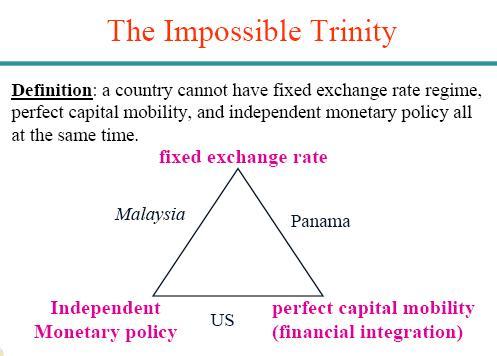
It is 'impossible' for straightforward reasons: if capital is free to move in and out, and the exchange rate is fixed, then money can swing in and out in huge quantities and play havoc with domestic inflation and interest rates -- which then rules out an "autonomous" monetary policy.
This is well known to economists, of course. And it provides a useful framework to understand what Y Venugopal Reddy, the RBI governor, is trying to do through monetary policy. Among other things, it might tell us what is in store as we move through the new financial year.
For a start, Dr Reddy has clearly indicated that the tolerance limit for inflation in India is now 5 per cent, if not less.
Old-timers will recall that the politically tolerable limit for inflation used to be reckoned as 10 per cent, while the long-term average inflation rate for India is around 7 per cent.
The limit today is not set by political compulsions, though. It is set by the fact that the inflation rate in the developed countries is about 2 per cent. If we want to integrate the Indian economy with the rest of the world, then our inflation rate must start getting closer to theirs.
But targeting a tighter inflation limit of 4-5 per cent means that both interest rates and money supply will be used far more frequently to stay within the acceptable inflation band (hence Dr Reddy's introduction of a new quarterly policy cycle).
And it is today's latent inflation that has persuaded Dr Reddy to signal higher interest rates early this week. What this suggests is a strong desire to have an autonomous monetary policy, directed at achieving clear domestic goals.
Take the exchange rate next. The RBI has traditionally tried to hold the "real" (i.e. inflation-adjusted) value of the rupee constant against a basket of currencies.
That undeclared policy still holds, which means that the RBI wants one of the legs of the trinity: stable exchange rates. Yet, the RBI does not always intervene to ensure that the rupee is valued as officially desired.
By one calculation the rupee today is about 4.5 per cent higher than what the "real value" policy would dictate. In that sense, the rupee is allowed to float within limits; as they say, it is a policy of "dirty float".
Then take the third leg of the impossible trinity: capital flows. If the rupee is ruling stronger than what the RBI would like, one reason is the strong capital flows into the country's stock market.
And at the interest rates that exist in the Indian system, even more money would come in and be invested in the debt market -- if the RBI would allow the big institutional players to do this.
But it won't, because this would affect all the variables negatively (as the RBI sees it): it would send the exchange rate even higher, and it would cause problems in managing the money supply (which would impact inflation).
Therefore, the RBI keeps a lid on further opening up to capital account convertibility, frustrating many reformers.
In short, the RBI is forced to have the rupee value float, but it will be a dirty float. It is willing to have some degree of capital account convertibility (FIIs do move in and out of the stock market, and other transactions too have been freed from controls), but within limits and only in some forms -- in other words, partial convertibility.
What it will not compromise on, it seems, are inflation and interest rates -- among other things, because the size of the government deficit translates into a government borrowing level that in some ways supersedes all other considerations.
If that were not there, the RBI would be willing to let the currency and money markets have a freer run, but that is not to be.
So, as someone in the RBI admitted frankly, for the foreseeable future the central bank's policy objective will have to remain the attainment of a "dirty trinity".


Ben Sancho of France surfs a wave during the Air Tahiti Nui/VZ Trials in
Teahupoo, Tahiti April 28, 2005
From the Financial Times-
'China's currency traded briefly outside its tightly controlled band on
Friday, triggering a renewed wave of speculation that the government was
preparing to allow a long-expected revaluation.
The unexpected price move followed weeks of international pressure on
China to allow the renminbi to appreciate. But the People's Bank of
China, the central bank, said it had made no decision to change its
exchange rate policy.
A spokesman blamed “technical problems”. But some dealers speculated
Beijing had allowed the renminbi to appreciate as a “dry run” to see how
far and fast it might rise.
Traders said the renminbi, pegged to the US dollar for a decade, was
briefly in the market at a rate of Rmb8.2700 to the dollar, outside the
usual band of 8.2760 to 8.2800.'
The background for this news story and the relation between the US and
China vis-a-vis the currency situation- China for the last ten years has
pegged its currency to the US dollar. But over the years the trade
relation between US and China has become severely lop sided in favor of
China. Coupled with this is the fact that the US has had record trade
deficits in the last few years. The Americans believe that if China
allows its currency to float in the free market, then it will revalue
i.e go up in value. This will make American made goods more competitive
and help the balance of trade. Since there is tough trade competition
among countries in East and South East Asia for trading with the US, if
China allows its currency to go up then other countries will also
tolerate stronger currencies. All this will help US claw back on its
trade deficit.
Everybody wishes the answers to world economic problems were this simple
:) Firstly US trade deficit with China is only a small part of their
entire trade deficit. Their problems in this regards are much deeper.
Secondly if the Chinese are pressurised into floating or revaluing their
currency (I am not sure the chinese can be pressurised into anything !)
it is not clear how well they would be able to manage this and what
effect this would have on the world economy. But i guess people in the
US are becoming impatient and there have even been moves towards
protectionism i.e trying to impose tarrifs on Chinese goods. Ofcourse
most of these moves are against WTO regulations and finally how many of
them get passed into action will have to be seen.

Its difficult to read what the guys are saying to I will transcribe.
Calvin: You'll never get ahead by lying around, you know.
Hobbes: Who are we racing?
Calvin: Obviously, were ... um .. well .. .. uh !
Calvin: I'm too busy to explain this stuff! I've got important work to do! Very important!
Hobbes: Let me know if you win.
How true!
Calvin and Hobbes by Bill Watterson. My Favorite cartoon strip ! I found
out a litte more background about the strip. Its an excerpt from one of
Bill Watterson's Books. Ofcourse if u want to read more ... Google :D
*Calvin*
Calvin is named for a sixteenth-century theologian who believed in
predestination. Most people assume that Calvin is based on a son of
mine, or based on detailed memories of my own childhood. In fact, I
don't have children, and I was a fairly quiet, obedient kid--almost
Calvin's opposite. One of the reasons that Calvin's character is fun to
write is that I often don't agree with him.
Calvin is autobigraphical in the sense that he thinks about the same
issues that I do, but in this, Calvin reflects my adulthood more than my
childhood. Many of Calvin's struggles are metaphors for my own. I
suspect that most of us get old without growing up, and that inside
every adult (sometimes not very far inside) is a bratty kid who wants
everything his own way. I use Calvin as an outlet for my immaturity, as
a way to keep myself curious about the natural world, as a way to
ridicule my own obsessions, and as a way to comment on human nature. I
wouldn't want Calvin in my house, but on paper, he helps me sort through
my life and understand it.
*Hobbes*
Named after a seventeenth-century philosopher with a dim view of human
nature, Hobbes has the patient dignity and common sense of most animals
I've met. Hobbes was very much inspired by one of our cats, a gray tabby
named Sprite. Sprite not only provided the long body and facial
characteristics for Hobbes, she also was the model for his personality.
She was good-natured, intelligent, friendly, and enthusiastic in a
sneaking-up-and-pouncing sort of way. Sprite suggested the idea of
Hobbes greeting Calvin at the door in midair at high velocity.
With most cartoon animals, the humor comes from thier humanlike
behavior. Hobbes stands upright and talks of course, but I try to
preserve his feline side, both in his physucal demeanor and his
attitude. His reserve and tact seem very catlike to me, along with his
barely contained pride in not being human. Like Calvin, I often prefer
the company of animals to people, and Hobbes is my idea of an ideal friend.
The so-called "gimmick" of my strip--the two versions of Hobbes--is
sometimes misunderstood. I don't think of Hobbes as a doll that
miraculously comes to life when Calvin's around. Niether do I think of
Hobbes as the product of Calvin's imagination. The nature of Hobbes
reality doesn't interest me, and each story goes out of its way to avoid
resolving the issue. Calvin sees Hobbes one way, and everyone else sees
Hobbes another way. I show two versions of reality, and each makes
complete sense to the participant who sees it. I think that's how life
works. None of us sees the world in exactly the same way, and I just
draw that literally in the strip. Hobbes is more about the subjective
nature of reality that about dolls coming to life.

Yongtai nuns and Shaolin monks perform together in a new show "
Lotus&Sword " in Barcelona, Spain, April 26, 2005. The Chinese troupe is
in Barcelona as part in a spectacular show that has made them famous
across the globe. - 26 Apr 2005 REUTERS/Gustau Nacarino
Went on a shopping spree today and bought $100,000 worth of imaginary
stocks :D ! So now I am an imaginary owner of some really big companies.
I used the features in yahoo to make my portfolio and it'l be fun
tracking its progress down the road.
The financial world has become so complicated and competetive that it is
impossible for a small investor to make very large returns. The stock
market is still the best bet for getting returns ... but nobody should
expect miracles. The Catch phrase it "You cant beat the market", there
are thousands of analysts in big investment banks and hedge/mutuaul
funds who spend the better part of their day tracking investment
opportunities, so every individual investor should realise that he will
never be able to spot something in the market that'l make him load of
money instantaseously. The fundamentals are 1. Be reasonable with your
expectation, 2. Realise the risks involved and be ready to take hits 3.
Aim at the long term 4. Diversify !
Anyways ... my procedure for choosing stocks was simple- Go for the
really big companies with known track record. Diversify by choosing
companies from different segments. Most of my companies are taken right
out of the S&P500 and DJIA. These include google, microsoft, amazon,
verizon, intel, shell, best buy, wallmart, catterpillar, american
express, dow jones, johnson and johnson, nike, morgan-stanley, MMM,
Hershey. Thats $100,000 right there !! cool.

Yet another amazing photograph for the reuters collection. They have the
most amazing photographs ranging from politics, world crisis, sports
etc. Really ... a photo is worth 20 blogs !! ... read this at some blog
site :)
Anybody with a little free time on their hands check this out
http://crux.baker.edu/cdavis09/roses.html#instructions . Have fun!

There is a bunch of tulips growing across the road from my window where
i sit and study- and they look fabulous when the morn sun falls on them.
Thought I would take a snap before they vanish. Came out pretty nice.
For starters have fun reading some stuff I found on the net. Maybe
there'l be a time I will put something more useful here :)
I found them on somebody else's blog page. http://www.themermaid.blogger.com.br/
Zen-type Thoughts for the Day
1. Do not walk behind me, for I may not lead.Do not walk ahead of me, for I may not follow. Do not walk beside me either. Just pretty much leave me the hell alone.
2. The journey of a thousand miles begins with a broken fan belt and a leaky tire.
3. It's always darkest before dawn.. So if you're going to steal your neighbor's newspaper, that's the time to do it.
4. Don't be irreplaceable. If you can't be replaced, you can't be promoted.
5. No one is listening until you fart.
6. Always remember you're unique. Just like everyone else.
7. Never test the depth of the water with both feet.
8. If you think nobody cares if you're alive, try missing a couple of car payments.
9. Before you criticize someone, you should walk a mile in their shoes. That way, when you criticize them you're a mile away and you have their shoes.
10. If at first you don't succeed, skydiving is not for you.
11. Give a man a fish and he will eat for a day. Teach him how to fish, and he will sit in a boat and drink beer all day.
12. If you lend someone $20 and never see that person again, it was probably worth it.
13. If you tell the truth, you don't have to remember anything.
14. Some days you are the bug; some days you are the windshield.
15. Good judgment comes from bad experience, and a lot of that comes from bad judgment.
16. The quickest way to double your money is to fold it in half and put it back in your pocket.
17. A closed mouth gathers no foot.
18. Duct tape is like the Force. It has a light side and a dark side, and it holds the universe together.
19. There are two theories to arguing with women.Neither one works.
20 . Generally speaking, you aren't learning much when your lips are moving.
21. Experience is something you don't get until just after you need it.
22. Never miss a good chance to shut up.
23. We are born naked, wet and hungry, and get slapped on our rear ...Then things get worse.
24. Never, under any circumstances, take a sleeping pill and a laxative on the same night.
25. There is a fine line between "hobby" and "mental illness."
26. No matter what happens, somebody will find a way to take it too seriously.
27. There comes a time when you should stop expecting other people to make a big deal about your birthday... around age 11.
28. Everyone seems normal until you get to know them.

